A Guide To Hair Material On The Market
Nov 21,2025 | Lyric Ying
As a practitioner in hair industry, I am well aware that the hair products on the market are of mixed quality. The price of the hair ranges from several US dollars to several thousands US dollars. The biggest factor affecting the price of hair is its raw hair material.
This is a blog to help you figure out the raw hair materials in hair industry, so that to help you choose good quality hair at reasonable price.
This is a tree map that illustrates everything.
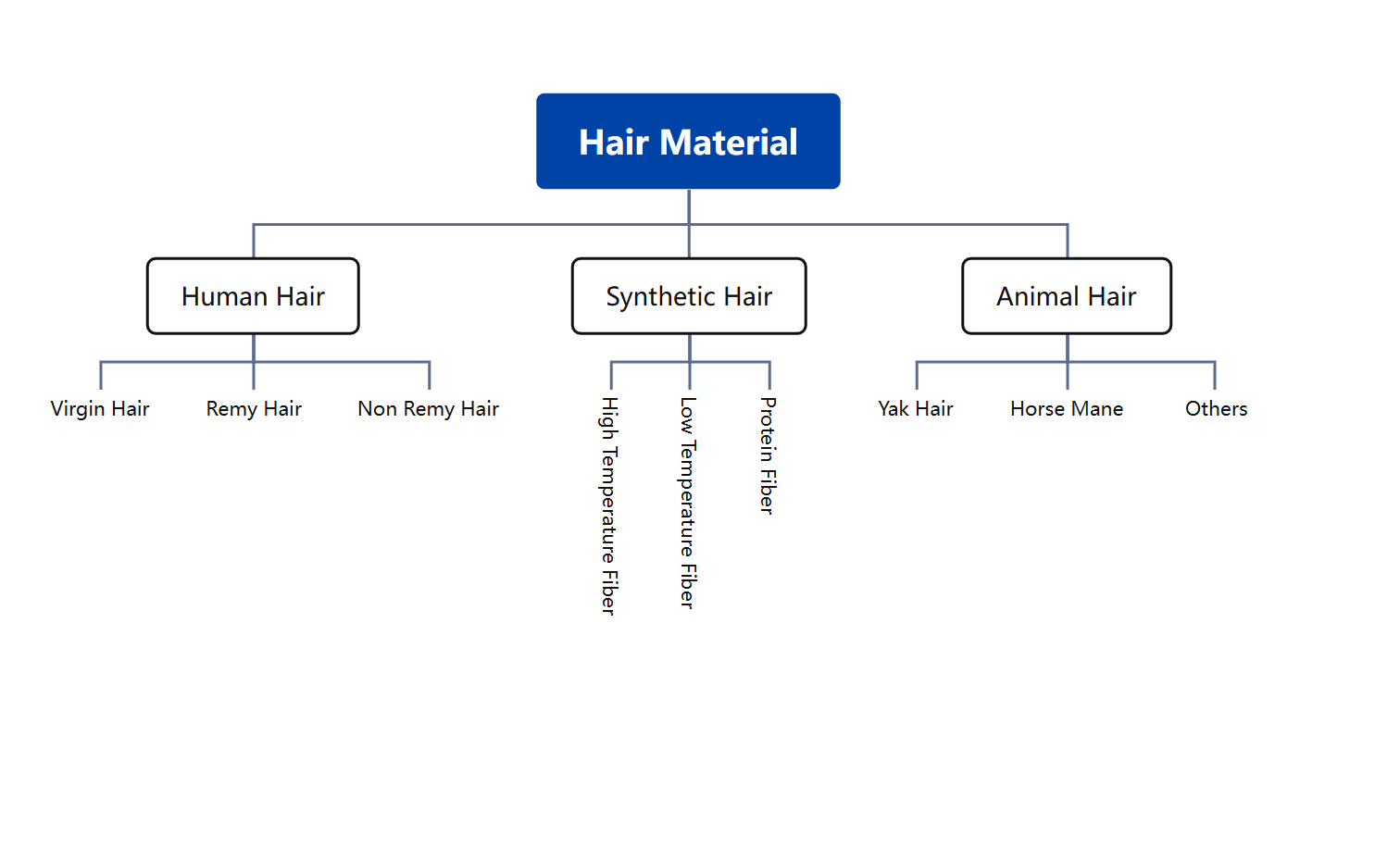
The raw hair material market in hair business is divided into three major categories, which is human hair, synthetic hair and animal hair. And each category is further divided into several subcategories.
Let’s start from human hair.
1. Human Hair
Generally speaking, human hair is divided into non-remy hair, remy hair and virgin hair.
1.1 Non Remy Hair
Non remy hair is the cheapest human hair. The raw material of non remy hair comes from the hair that ladies shed when combing. In some Southeastern Asian countries, like Burma, Vietnam, Cambodia, ladies there would collect their hair in daily life, after they collect to a amount, they would sell their hair to the hair dealer in exchange of money.
However, ladies in India would donate their hair to temples to express respect and dedication to the deities. Then the temple would sell the donated hair to hair dealers.
The hair collected in such ways is mixed up with the hair roots and tips and can not be used to make hair extensions directly.
One usual processing method is by acidification. Through acidification, the cuticle on the hair layer is lifted, however, hair goes through acidification will becomes lighter in weight,so the hair is more stringy.
As the cuticle is almost damaged by acidification, the non remy hair easily get frizzy and tangled after washing.
1.2 Remy Hair
Unlike non remy hair, remy hair, the root and tips of the remy hair is aligned, while the method to make them aligned is by machine. Through machine, the mixed hair roots and tips are arranged in one direction, therefore the cuticles are also in the same direction, making the hair less likely to get tangled.
Without going through excessive acidification, the cuticles of the remy hair is not seriously broken, therefore, remy hair is more durable than non remy hair.
1.3 Virgin Hair
Here comes to the virgin hair. The raw material of virgin hair is totally different from the two above hair, which is cut from the donors directly. In some rural areas in China and Vietnam, ladies grow their hair long to sell. Compared with hair that falls out naturally, hair cut off directly from donors is healthier. Raw hair material of the virgin hair is not mixed, and has aligned cuticles from the beginning. Without going through acidification, the cuticles of the virgin hair is retained intact.
Aligned & intact cuticles has a crucial influence on the appearance, texture and life span of the hair. Neatly arranged hair cuticles make the surface of the hair smooth, reducing knotting and tangling. Moreover, healthy and intact hair cuticles enable the hair to reflect light naturally, thereby showing a natural luster. The virgin hair’s life span is over one year, for high quality virgin hair, the life span can reach to three years.
2. Synthetic Hair
The synthetic hair is divided into three categories: high temperature fiber, low temperature fiber and protein fiber.
2.1 High Temperature Fiber
High temperature fiber can withstand high temperature below 200 degrees Celsius. So it can be restyled. High temperature fiber can replace long length hair that human hair can not reach , and is often used in producing dreadlocks.
2.2 Low Temperature Fiber
Low temperature fiber is not resistant to high temperatures. It can remain unchanged in shape when heated to 80 degrees Celsius, but it can not be restyled because low temperature fiber is flammable and will form lumps after burning.
2.3 Protein Fiber
Protein fiber is a higher quality raw material compared with high temperature fiber and low temperature fiber. Its texture is similar with the human hair, so some vendors will mix protein fiber into human hair to save cost. However, protein fiber can not be permed or dyed and can not be exposed to high temperature, otherwise, it will be damaged.
So here is a simple way to tell human hair from protein silk. Hair made of 100% human hair can be straightened or curled with a hair iron heated to 220 degrees Celsius. If there s no paste-like smell or appearance, it is 100% human hair. Conversely, if there is a burnt paste-like smell or appearance, it indicates that the hair is mixed with protein silk.
All kinds of synthetic hair can not be bleached or dyed. The lifespan of synthetic hair is relatively short, as it will become frizzy in less than a few months.
3. Animal Hair
To save cost, some hair vendors use animal hair (such as goat hair, yak hair, camel hair, etc) to mix with human hair. For example, African People’s hair is naturally curly and the texture is similar with the yak hair. Also , white goat hair can be slightly processed and used in the grey hair of the elderly. However, animal hair length is usually shorter than 10inch, so if you purchase long hair, there is no need to worry about it.
So this is a brief introduction on the hair material on the market,what else do you want to know about the hair material,and which kind of hair material do you prefer,just comment below!
Thank you for your reading~
Comment